The Only Study System You’ll Ever Need: The RSA Method
Introduction
In the last few weeks, I have explored the themes of Review, Solidify, and Apply in the context of learning. In these articles, I approached these three themes as three separate frameworks to approach studying in a scientific, research-backed manner. Although presented separately, these three “steps” to studying are part of a learning paradigm that I call the RSA Method - the Review, Solidify, and Apply Method.
When we speak about the act of learning in a scientific sense, it can be broken down into a three-step process: Encoding, Consolidation, and Retrieval (Rocha et al., 2018). As I’ve tutored and academically coached students for the past 8 years, I’ve noticed that a lot of students struggle with the consolidation phase of learning, greatly impacting the results of the Retrieval phase, which usually takes the form of doing poorly on tests. As a research-backed study coach, I wanted to create an approachable study template that students could follow that would aid them in developing a system for the consolidation phase of learning. As I was reading the literature, three common themes emerged in the consolidation process: the retrieval of prior information (Review), the connection between prior information and new information (Solidify), and the self-assessment through application of that new information (Apply).
In this article, I aim to explore the RSA Method with you and demonstrate that it is a fundamental template for students to use and customize to best suit their learning.
Review
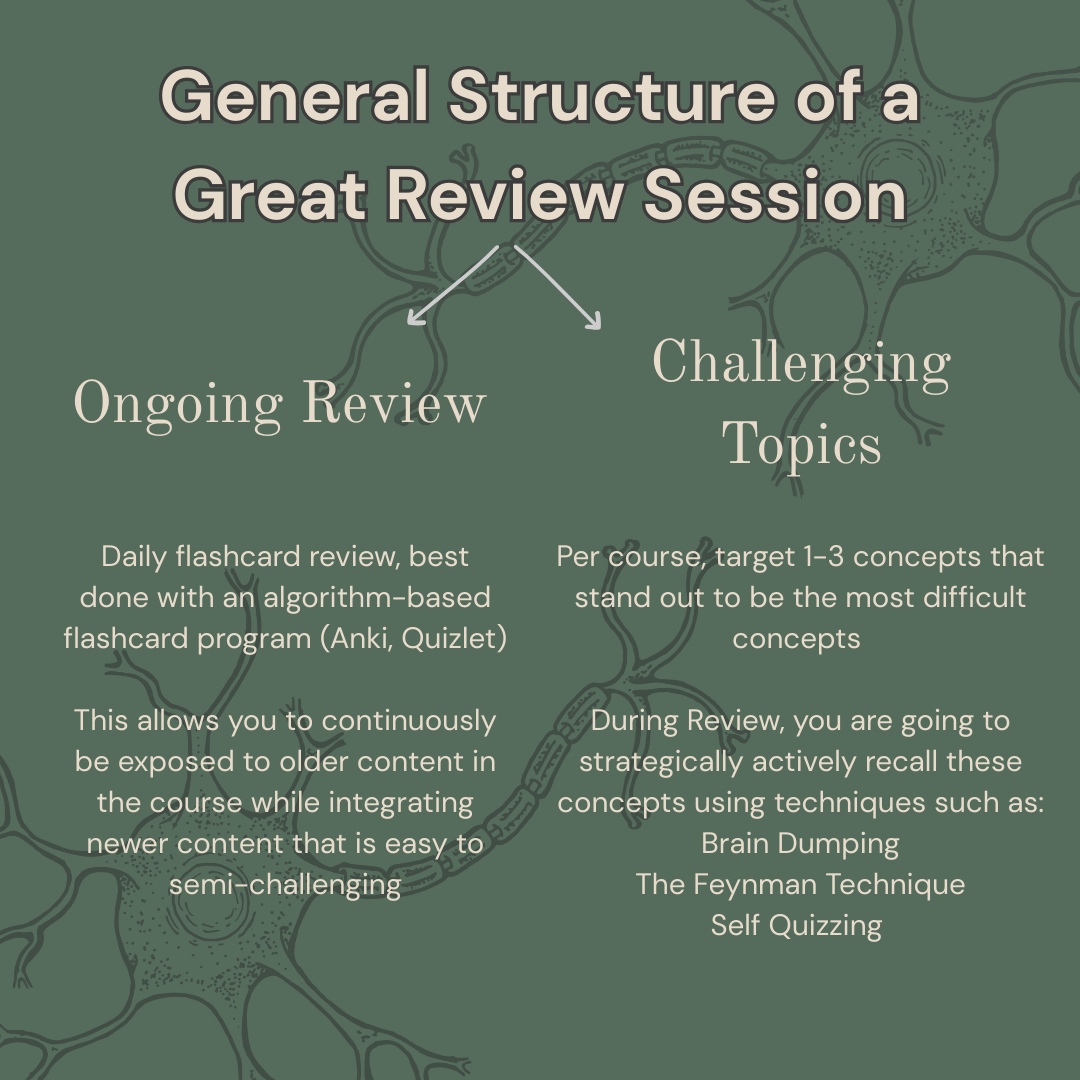
In my article, The Importance of Review, I explored the idea that reviewing material in a thoughtful and methodical way is not new to the understanding of how learning works. In fact, there are so many studies out there that explore the impact of active recall and spaced repetition on the process of learning. Some notable studies are Sweller 2010 who suggests that repeated exposure to and the retention of foundational information has a key role in processing new information, and Kang 2016 who speaks to the importance of active review in its ability to enhance our problem-solving abilities. All of this to say, incorporating Review into our study practice is far more than just doing flashcards and memorizing facts. The process of review allows us to prime our brains for new information by activating pathways of previous knowledge and schemas, which makes it easier for us to connect it with new ideas when we move onto the Solidify stage.
Personal Example of Review
When I was in university, I was taking my very first biochemistry class, and I was tasked with memorizing all 20 essential amino acids. I had to know their one and three letter abbreviations, their organic structure, and the chemical properties to group and classify them. On top of the Anki deck I had for that class, I would spend an additional 5 minutes at the beginning of my Review to write out all the abbreviations of the amino acids on the whiteboard in my room. I’d then quiz myself on the different classifications and how I could group them together. When the exam came around, there was no need to cram - I had spent the entire semester committing the amino acids to long term memory (by just doing 5 minutes a day!) and knew them like the back of my hand.
Solidify
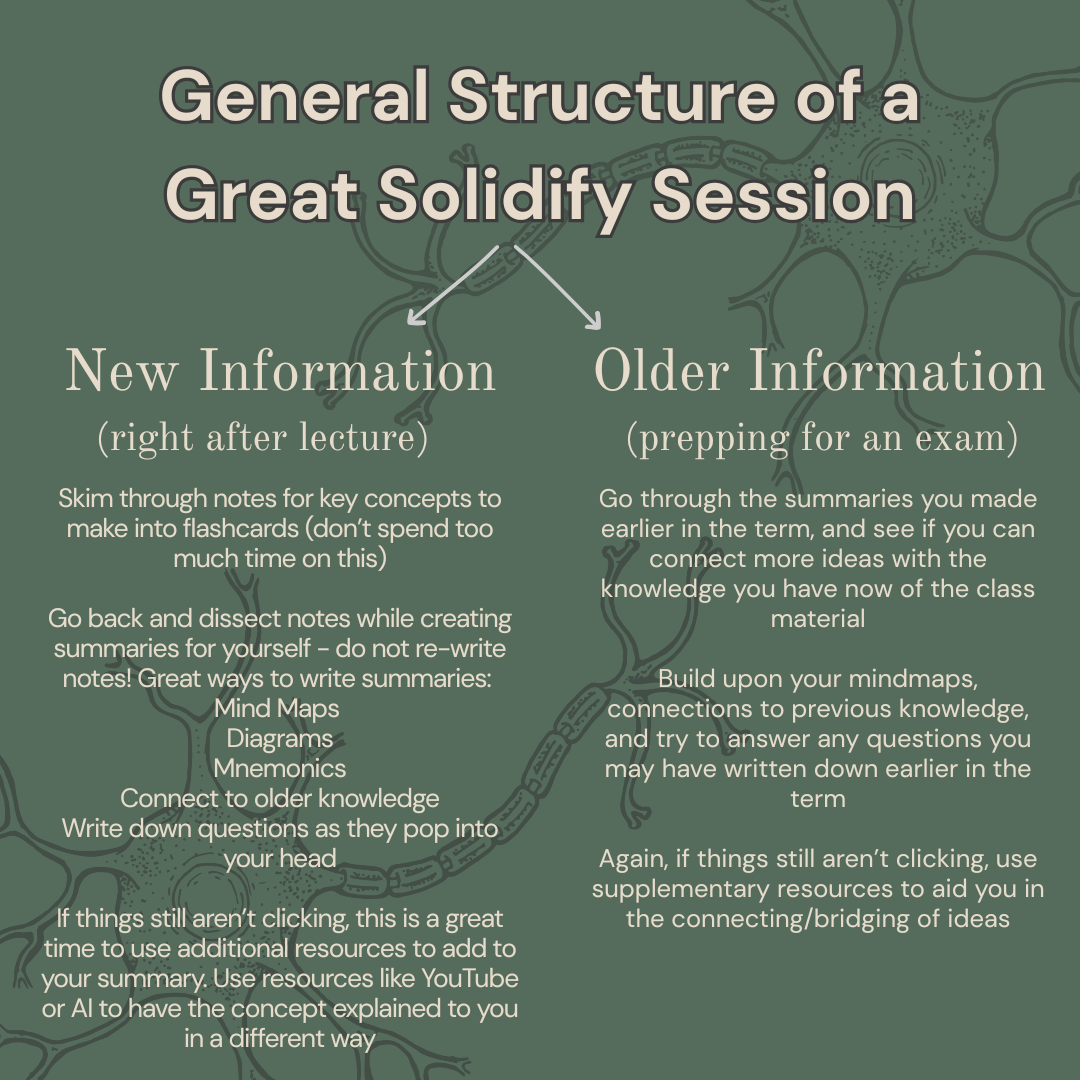
If Review is the priming of the brain by activating older schemas and pathways, Solidify is the bridge we create between those old pathways, with the new pathways. In my article, Beyond Cramming - Use Solidification to Master any Subject - I broke the Solidify stage into three steps: connecting to prior schemas, the organization of ideas, and rest. Solidify is the main stage for the memory consolidation process, where our main objective is to create new neural connections in the brain with the new information we’re trying to learn. We’re not trying to commit it to memory right away, or even attempt mastery right away (despite the title of my article). What we want to accomplish is organizing concepts in our brain so that the synaptic connection can be easily revisited (for further consolidation) during Apply and Review.
Personal Example of Solidify
I found myself in the position where I needed to challenge a six-credit anatomy and physiology class in three months while working a full-time and part-time job. This required me to be completely self-sufficient and teach myself the course content out of the textbook.
Although an incredibly daunting task, each day, I had the goal of solidifying 2-3 chapters. I would read through the chapter and make flashcards as I read through, making note of particularly difficult/new concepts to me. Once I had read through the chapter, I zeroed in on those challenging concepts. I would dissect essential information in the textbook and write my own summary using sketches, mind maps connecting it to things I already knew, coming up with funny mnemonics, and practicing elaborative interrogation to test my understanding.
If I ever felt like I still wasn’t connecting the challenging concept to previous knowledge in my brain, I would find external sources to have it explained/shown to me in a different way. This system worked brilliantly and allowed me to accomplish small goals everyday that with consistency and perseverance, allowed me to finish the course in time.
Apply
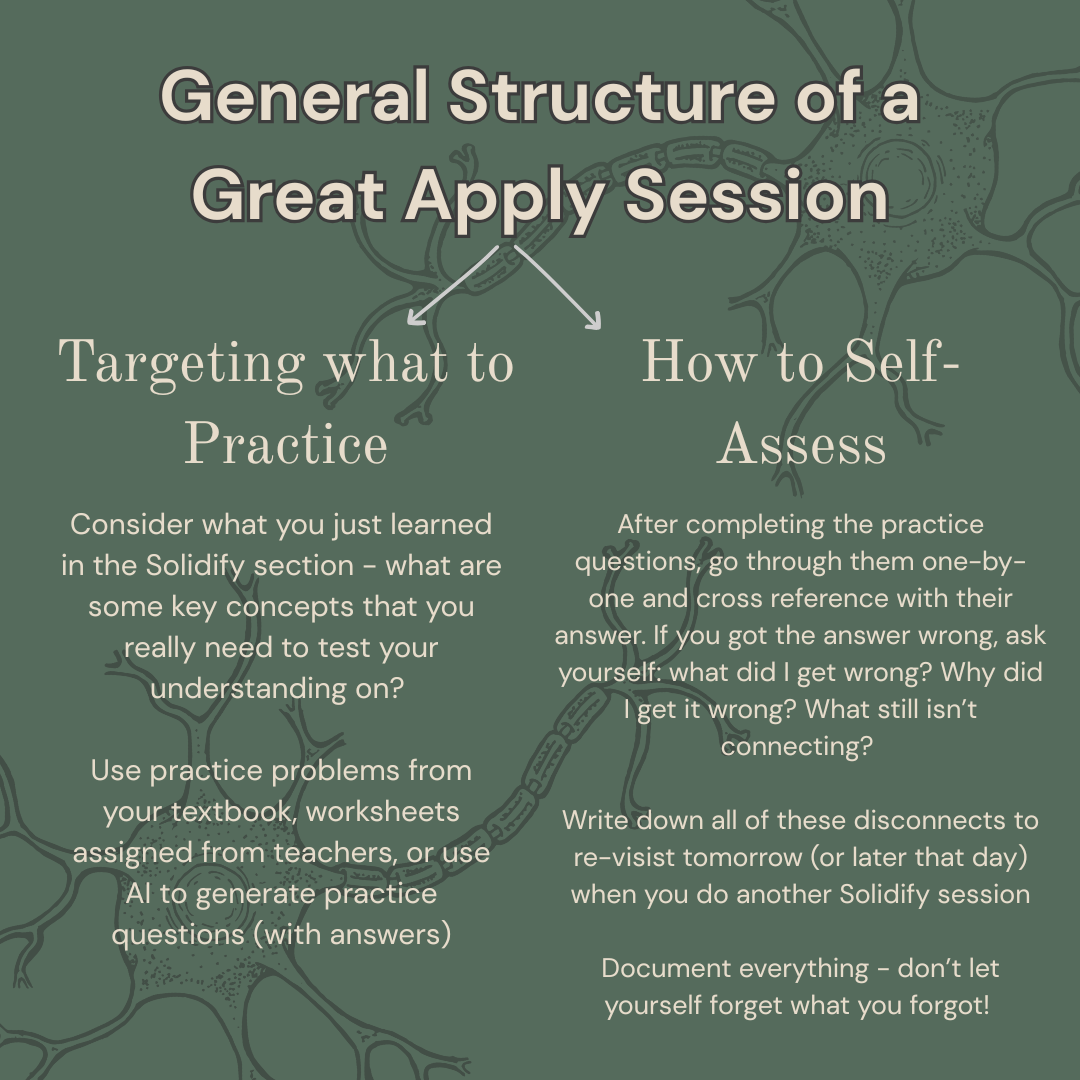
Finally, we’ve reached Apply, which I consider the “practice stage” for the final stage of learning, Retrieval. As I explored in my article, Applying Knowledge for Academic Success, the Apply stage is used to practice the process of analyzing what a question is asking us, retrieving the information we need to use to answer it, and interpreting the knowledge we retrieved to formulate a proper solution. However, there is one final step to Apply that cannot be overlooked: self-assessment. Self-assessment is a practice of metacognitive skills that allow us as learners to evaluate and assess what we did wrong, why we got it wrong, and what actions we can take to not make that mistake again (Hartman 2002). Without this final step, the Apply stage isn’t nearly as effective. Let this final stage of the RSA method be a guiding point to your areas of improvement and help you recognize your progress in learning.
Personal Example of Apply
The RSA Method isn’t limited to Science, Math, or other school subjects - it can expand to so many different learning-based things in our life. As a classical pianist, I break down pieces of music into sections to practice. One could see this as my “Solidify” stage. This works great and allows me to focus on tricky passages and learn them efficiently, however, when I play at a recital, I can’t play section by section. For my “Apply” stage, I try to play the piece from the beginning and pretend like I’m performing it. I’ll even set up my phone and record myself playing for some extra pressure. It’s amazing how that same section I got right 100 times in isolation completely falls apart when I try adding it to the rest of the piece. I think this is a great example of how Apply works - it’s about practicing for that final performance. When I mess up, I evaluate why I made that mistake. Usually, it tells me that I was overconfident with my skills and I didn’t actually practice that section (or transition into that section) as well as I thought I had. This becomes my target for tomorrow’s practice (Solidify).
Conclusion
The incredible thing about the RSA Method is that it is a one-size-fits-all template. I can say that because each stage of this method is based on the physiology of how our brains consolidate learning. However, how you approach the RSA Method is individualized to account for the differences in our brains. Maybe your RSA cycle is only 20 minutes long. Maybe it’s an hour. Perhaps you only like to do brain dumps for Review and never flashcards, or you like to make jingles to consolidate new learning in Solidify. It doesn’t matter! Learning is so unique because you are so unique. What I hope the RSA Method provides you with is a deeper fundamental understanding of how your brain is going to optimally learn, and gives you the template that you can customize to make it work for you.
I implore you to try some of the techniques I’ve listed in each section and give the RSA Method a try the next time you sit down and study. I’d love to hear from you and how you approached your studying template with the RSA Method at the email address info@thestudyingedit.com.
Citations
Hartman, H. J. (Ed.). (2001). Metacognition in learning and instruction: Theory, research and practice. Springer Netherlands.
Kang, S. H. K. (2016). Spaced repetition promotes efficient and effective learning: Policy implications for instruction. Policy Insights from the Behavioral and Brain Sciences, 3(1), 12-19. https://doi.org/10.1177/2372732215624708
Rocha, E., Costa, B., Ferreira, I., & Fregni, F. (2018). Neural basis of learning. Revista de Medicina, 97(1), 1-6.
Sweller, J. (2010). Cognitive load theory: Recent theoretical advances. Perspectives on Psychological Science, 5(3), 286–298. https://doi.org/10.1177/1745691613506598
